The CAESAR Project drives scrap recycling towards a zero-waste European steel industry

Today, the European Union's steel sector is a modern industry whose main customer base lies in EU internal markets, particularly in high-end segments. However, in line with the European Green Deal and the vision of the CleanSteel Partnership, challenges remain to keep the EU steel sector globally competitive and climate-neutral.
The use of scrap in steelmaking is a common practice for improving the sustainability of the process, as it reduces the use of raw materials and promotes sector circularity (lowering CO₂ emissions and energy consumption). Today, post-consumer scrap grades are not suitable for most applications, which limits their use in steelmaking. To increase steel scrap recycling capacity and energy efficiency, while maintaining EU competitiveness and security in terms of raw material imports, energy consumption and climate change impact, it is necessary to develop innovative technologies to "clean" scrap before it reaches the steel furnaces.
The CAESAR project brings together steel producers, recyclers, technology developers and research centres in a joint effort to validate, at industrial scale, integrated scrap upgrading, sorting and characterisation technologies, enabling the exploitation of large volumes of low-quality scrap in Europe, while maintaining a high-quality product and generating valorisation routes for all non-ferrous fractions obtained, towards a zero-waste steel sector.
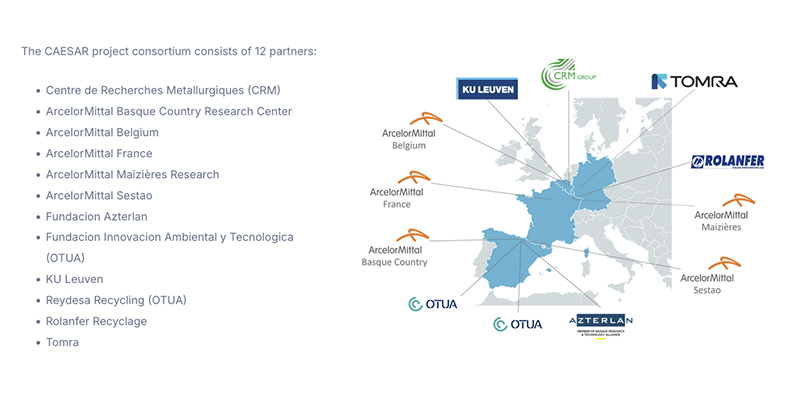
Consortium:
CAESAR Project funded by the European Community's Horizon 2020 Programme (RFCS) under Grant Agreement No. 101058520 – CAESAR - HORIZON-CL4-2021-TWIN-TRANSITION-01